Goodwill Without the Glut: Questioning Modern Christmas Traditions
Much of what we call goodwill at Christmas is little more than ritualised obligation, performed once a year in place of genuine care sustained over the other eleven months.
By Featured Writer, J E Rudd.

On the rare occasions when I have been obliged to send Christmas Cards, I prefer to use the phrase ‘Season’s Greetings’ over ‘Happy Christmas’ or its many variations. As a non-Christian, I feel this greeting is more acceptable to Pagans and people of other denominations. I am acknowledging the winter solstice in sending greetings at this time, not a random date chosen as the birthdate of a prophet who lived 2000 years ago, or even the fairly random assignment of dates in general, which makes the 1st of January the start of the calendar year for most people. In my opinion, what is being marked is the acknowledgement of the winter solstice; the subsequent and gradual lengthening of the days until we reach summer again.
Why should winter be the season in which we do this? In temperate regions, there is a distinct change of seasons from winter, spring, summer to autumn, a fact that we are aware of in the way we dress or the things that we look forward to, but which we barely acknowledge. The equinoxes, those two days of the year when daylight and nighttime are equal, are not celebrated by sending cards and gifts, although the pagan celebration of Eostre has been almost subsumed by the Christian Easter. This festival, in my mind, is one of the strangest mixes of all, incorporating fasting and belief in the rebirth of Christ with the symbology of eggs, and this somehow translating into increased sales of chocolate. This movable feast takes place according to the lunar phase, which seems odd when most Christian festivals are fixed days, yet it is rarely co-incident with the equinox, which, before the advent of accurate time keeping devices, would have been the most reliable marker. Autumn Equinox is barely given a passing nod, harvest festivals in schools perhaps, but more people look towards Halloween, Fireworks on November 5th, Diwali or Thanksgiving. At Summer Solstice, I am more likely to meet up with friends at festivals, but as June is rarely that warm and school holidays don’t start for another month, Solstice is regarded as the start of summer, not the mid point.
In a similar way, in Britain at least, we can expect the weather to be colder and more wintry after the solstice. January and February are more likely to bring snow and ice than December, although it doesn’t seem to last for months on end as it did in my youth, but I certainly don’t look forward to it. It is probable that even since the days before records began, people would gather in the depths of winter to seek solace, warmth, and to share food. It is a basic survival instinct. The solstice may have been a marker by which, if you had not already found company, you would probably not see the spring. Animals that hibernate or migrate would have done so, and no winter berries or edible crops remained, except those that had been frugally stored. To share resources would have been central. Even in countries that are warmer, the shorter days and dark nights would have predisposed people to staying indoors more, perhaps engaging in communal tasks or arts and crafts. Thus, winter has become a season where communities gather and, when they can’t, thoughts often turn to those whom we are unable to see in person. We are aware of the fact that older members of our inner circle might not survive another season, and having more time on our hands, we are likely to think about those we will never see again.
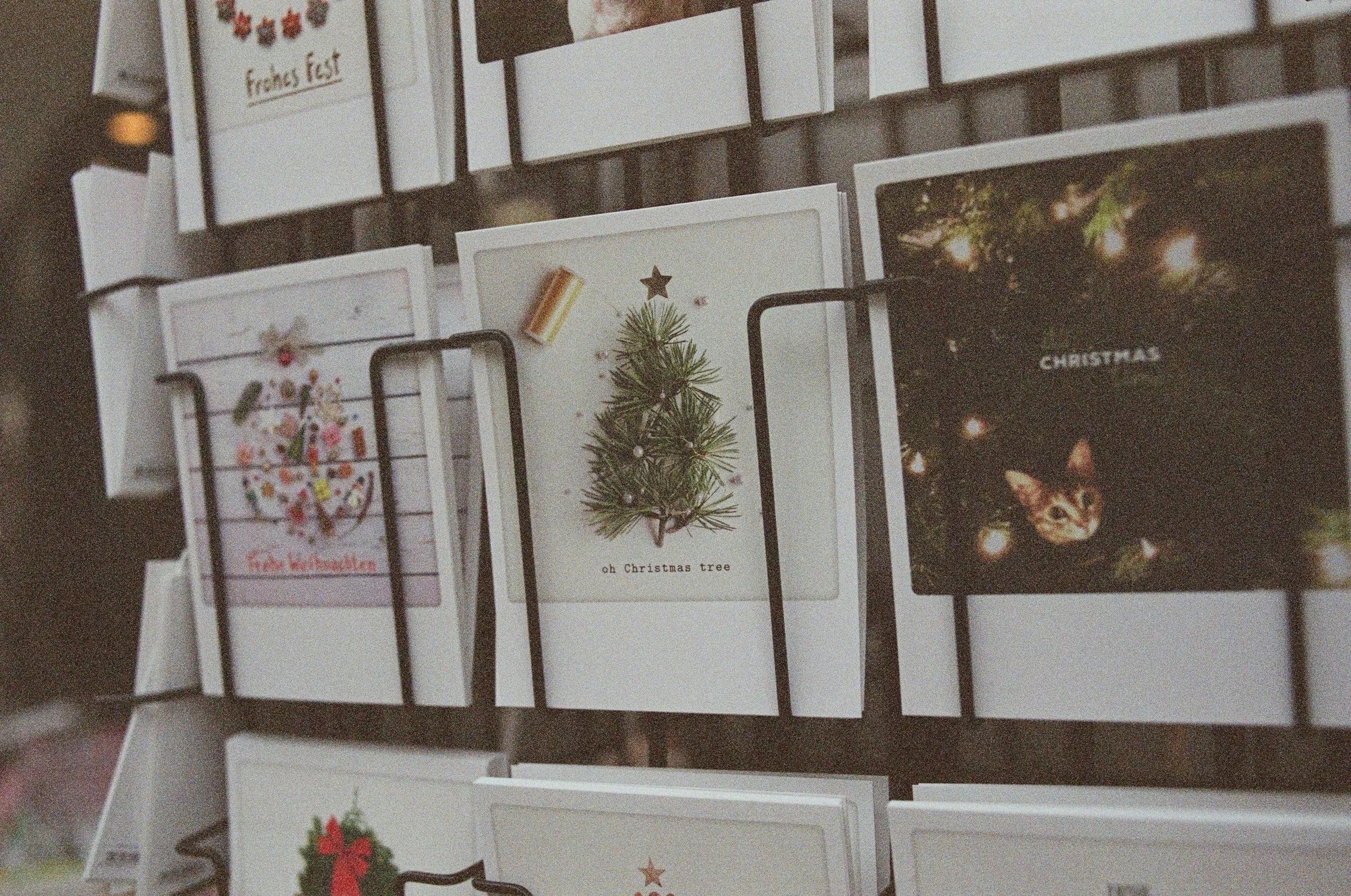
In this day and age, most people are widely scattered from friends and family, if not by continents, then by distances that make travel unappealing. In sending greetings to our friends, companions and loved ones at this time of year, we are acknowledging dark days ahead and hoping to bring a little light to our companions. It makes sense to use this time to contact people, to share news and greetings, even if this is the only occasion on which it is done. Perhaps it is because everyone is just so busy, but I would prefer to see people keeping in touch throughout the year rather than just being another name on a list. It is nicer to get a random message from an old friend just to say you popped into their thoughts, asking how you are doing. Some people I know seem to only contact me if they have some boast to make, a new car perhaps; a grandchild or child has achieved some milestone or other or some such. It seems intrusive to message people to tell them your day to day woes, but it would be nicer if the gloaters actually asked after your welfare now and again.
Christmas greetings can feel like an amplification of this phenomenon. People who have forgotten your very existence for 12 months send you a card just so you can send one back and they can add to their collection and outdo their neighbours. People who send Christmas cards and don’t stay in touch the rest of the year don’t really write to ask how you are, they don’t remember or care how you got on at the hospital visit, got used to that new job or if you are coping financially. It is just a meaningless tradition without the goodwill to back it up, unless you actually bother to take an active interest in those people for at least some of the other 12 months. Perhaps we should make the effort to follow up on Christmas cards later in the year, using them as a starting point for a more meaningful conversation? Many people that I have loved have died in the summer, and I wonder how many of their acquaintances still sent out cards, not having bothered to keep in touch despite saying ‘best wishes for the coming year’ the previous December. It’s not to say that you shouldn’t send cards, but really, we owe it to our friends and relatives to keep in touch at other times if we care for them at all.
The giving of gifts is another Christmas tradition, whether derived from the communal sharing of food or from the gifts brought by the Magi to the infant Christ; it seems to me that it has precious little spiritual or religious significance in the modern day and age. From mid-October onwards, the season’s must-haves are promoted endlessly, whether it is the latest bit of gadgetry, a perfume, personal adornments or alcohol, there seems no escape as December 25th looms ever closer. Are these things the things we really need or want, any more than the baby Jesus was looking forward to having some myrrh?
Advertising makes us feel inadequate if we don’t meet up to their specified standards, and there is the dilemma of giving a gift that may be of significant lesser or greater cost than the one received. Don’t believe “it’s the thought that counts” - a phrase only used when the gift is completely valueless to the recipient. The feeling of obligation to buy something new for someone else just because everyone else is doing it feels amoral. Christmas seems to promote a sort of mass hysteria in people to buy something, anything, no matter how inappropriate, as can be witnessed in any department store on Christmas Eve. How many of us have bought a tacky ornament that will end up in a charity shop in a month, or a bunch of roses produced in a Kenyan hothouse by impoverished labour and ruining their climate and which will be dead two days later?

Giving gifts shouldn’t be about spending money; it should be about what the person would appreciate and the thought that went into choosing it - and timing. Why should there be this pressure on us to give presents at Christmas, and not when they might be needed? As for children, there is an additional pressure involved, that of punishment and reward. Whether it is Krampus or Santa Claus, Christmas gifts are dependent on good behaviour, although children don’t tend to get reminded about this on hot, sunny days. Gifts should be given with pleasure and received in the same way. There is great joy to be had from seeing someone’s face light up after being presented with something they wanted quite unexpectedly and spontaneously.
Communal feasting and sharing of food may once have been essential for survival in winter, but the tradition has become transmuted into what I can only describe as gluttony. Since the winter solstice and Christmas both fall around the third week of December, to have a massive feast at this time makes little sense, even in historic times. It would have been imprudent to use up all your stored foodstuffs on a day right at the start of the coldest part of the year, just as it is not a good idea to spend that early December paycheck knowing the January money won’t be in the bank for another six weeks. And yet we do just that.
While it makes more sense to have lots of small gatherings through the winter, everything is focused on the one “Big Day”, with advertising for months ahead. Once again, commercial pressure is on for us not just to provide a hearty meal for the family, but to overindulge. There must be vast quantities of everything, and in case that isn’t enough, extras as well. Do we really need 15 kinds of mince pies? It’s not as if we are going to hibernate and need the extra body fat to sustain us, but some people seem to eat as much on Christmas Day as a normal person might eat in a week. The desire to eat until utterly stuffed full, and then eat more, is not beneficial to our metabolisms, nor is it arguably ethical.
During my youth, I was taught not to waste food because “there are starving children in Africa”, but still to this day, I can’t reconcile how being an obese child benefited any Biafrans. The statement is such a non-sequitur and fails to address the issue. The problem is not that food is wasted by being left on the plate, although this is an issue, but the fact that we have so much food TO waste. The vast amount of commercially available prepared foodstuffs means that we can, if we have the money, go and buy just about any type of food at any time. If all the food we ate were available only as ingredients, there would have to be a lot more careful thought involved before deciding what to eat. Actually preparing a meal from scratch with love and care is therapeutic, and it makes us appreciate what we eat. Instead, there is a culture of instant gratification, which is even more in evidence at Christmas. Gone are the days when Christmas Puddings and Cake were started in October.
There are many reasons why a traditional winter festival should continue to take place. It can benefit us spiritually and mentally to enjoy the company of others, good food and giving gifts. We just need to remember that we should be able to maintain some of the spirit of goodwill through the rest of the year and that those happy moments are for life, not just for Christmas.